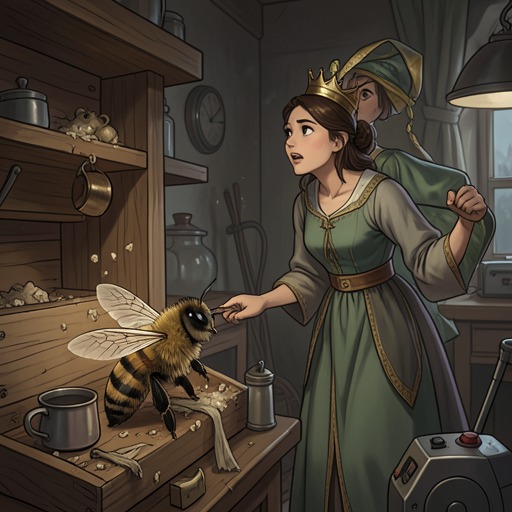
Maya Is Pardoned and Appointed as the Queen’s Adviser
The Adventures of Maya the BeeMaya’s pardon and appointment as Queen Helen VIII’s adviser resolve the conflict between her unauthorized departure and her proven loyalty to the Nation of Bees. After warning her people of the Hornets’ attack and helping them endure it, Maya asks forgiveness before the assembled court. The queen answers not with punishment but with an embrace and a place at her side: Maya’s experiences, gathered beyond the hive, are to serve the common good.
Causes and Background
Maya’s appearance at court follows a dangerous return. Imprisoned in the Hornet fortress, she learned of the coming attack and needed to reach home in time to warn her people. The sentinel guarding the way out had orders that no bee who entered the fortress could leave alive. He nevertheless made a personal bargain with her: if Maya told him where Loveydear lived, he would let her go. She gave him the location, and he kept his word, stepping aside from the entrance as day broke. His choice matters to the eventual pardon because Maya’s route home depends on a promise honored across the divide between enemies.
At the Bee-city (the hive), Maya’s return is not automatically welcomed. Two sentinels block the entrance and seize her; entering another bee city without the queen’s consent is a capital offense. Too breathless at first to explain herself, she gains entry by speaking the password by which the Bees recognize one another. The episode places her in a double position: she has broken the rules governing her people, but she has come back to protect them.
Her warning arrives as the Nation of Bees prepares for battle. The hive mobilizes with disciplined speed: soldiers take their assigned places, scouts report the approaching Hornets, and wax-generators narrow the entrance by building two thick partitions. Queen Helen VIII watches from an elevated position while officers organize the reserves. The preparations make visible the collective order Maya has put at risk by leaving, and the resourcefulness that will make her warning consequential.
The Audience and Maya’s Account
The battle is fought under that preparation. When the queen gives the order to defend the realm, the Bees attack as the Hornets press toward the entrance. The queen’s defensive arrangement allows fresh ranks to meet intruders farther inside, while the narrowing passage delays the assault. The fighting is severe, but the Hornets gradually lose their advantage; their strength cannot prevent their stings from weakening, and the Bees’ coordinated resistance eventually leaves the invading force defeated.
The aftermath gives the victory a political as well as military meaning. The Hornet leader sends an emissary to propose terms, offering to leave the Bees in peace if they surrender prisoners. Queen Helen VIII replies that there are no prisoners: the invaders who entered the territory are dead, and the Bees will fight again if necessary. An older Hornet observes that, although his people are more powerful, the Bees’ unity and unwavering loyalty make them formidable. His assessment echoes the quality the queen will later recognize in Maya—not obedience without exception, but a commitment to the welfare of her people.
After the battle, a messenger summons Maya to the royal reception room, where the full court has gathered. The assembly is unusually solemn, and some officers are absent, yet those present also bear the elation of victory. Queen Helen VIII crosses the room without attendants and takes Maya into her arms. Maya had not expected this welcome; overwhelmed, she weeps. The gesture precedes any formal judgment and makes the queen’s response personal as well as political.
Maya is asked to explain how she discovered the Hornets’ plan and escaped a prison from which no bee had previously escaped. She recounts what she encountered on her travels, including Loveydear, a grasshopper, Thekla, Puck, Bobbie, a Flower sprite, and human beings. Her account brings the outside world into the court: when she speaks of the sprite and the humans, the hall becomes so quiet that the wax-generators working at the back of the hive can be heard. The queen responds with wonder at the beauty of the sprites, allowing Maya’s report to carry more than military intelligence. It also conveys discoveries and encounters unavailable within the hive.
Pardon and Appointment
At the close of her account, Maya says that she has reached home and asks the queen’s pardon. The assembled Bees do not hold her departure against her; her return and service in the crisis have changed the meaning of that earlier disobedience. Queen Helen VIII puts an arm around her neck and explains that Maya did not forget her home or her people: her heart remained loyal. The pardon thus rests on the connection between intention and action, made visible by Maya’s perilous effort to bring warning back to the hive.
The queen’s decision goes beyond forgiveness. She appoints Maya to remain beside her and help conduct the affairs of state. The reason is explicit: the experiences and knowledge Maya has gained are to be put to work for the greatest good of her people and country. What began as solitary exploration becomes a resource for collective government. Maya does not simply return to her former place; the queen gives her a new responsibility shaped by what she learned outside it. Cheers of approval from the court confirm that the appointment is received as a public settlement, not merely a private favor.
Aftermath and Significance
The pardon closes the central tension between freedom and belonging without treating Maya’s travels as wasted or her departure as harmless. The queen acknowledges that Maya left, but judges her by the loyalty demonstrated when the Bees faced danger. In turn, Maya’s appointment binds her hard-won independence to service: the wider knowledge that separated her from the hive is now given a role within its political life.
The story’s ending records the consequences of that settlement. Maya’s work is said to contribute greatly to the Nation of Bees’ welfare, and her people come to respect and love her. She also visits Cassandra, now living in a peaceful room on pension honey, and tells young Bees the adventures they have heard through the narrative. Her story therefore passes from individual experience into communal memory. The queen’s act of welcome restores Maya to her people, while her new office and later storytelling preserve the value of the world she encountered beyond home.